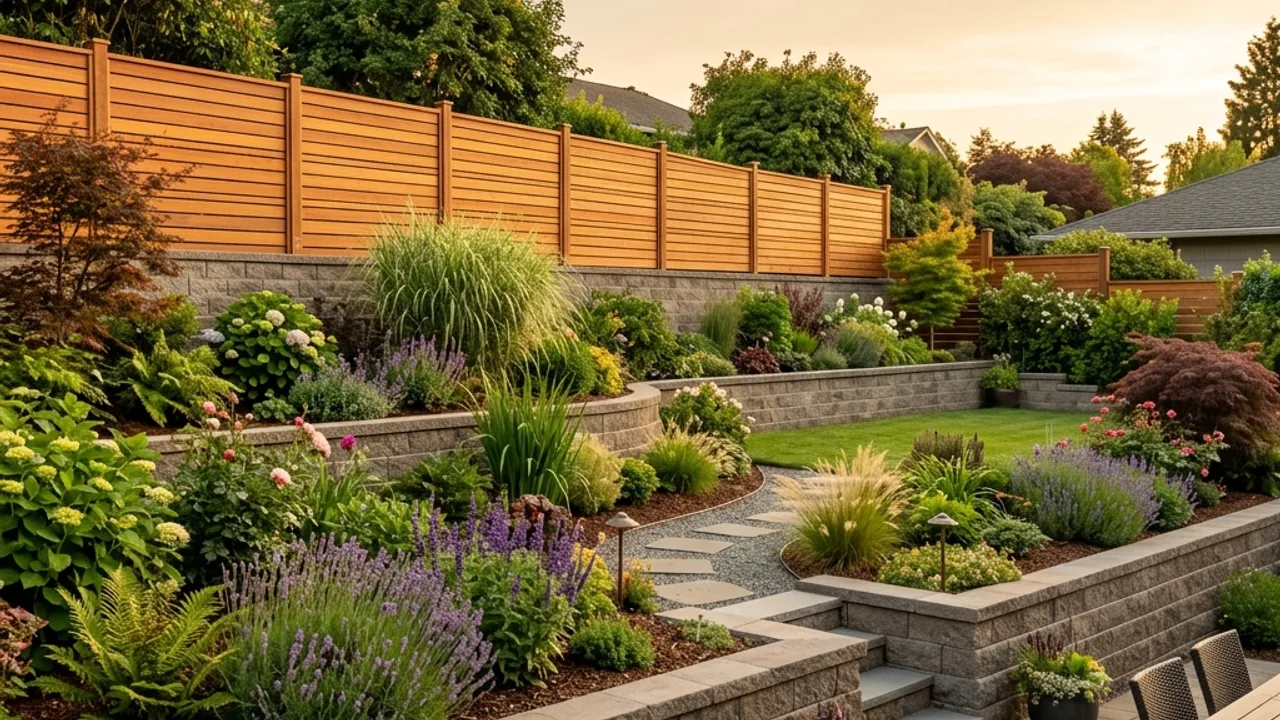
Retaining wall installation and fencing questions answered, a finished landscaped Queensland backyard

Retaining Wall and Fencing Questions, Answered

27 questions covering both trades across Brisbane, Ipswich, the Gold Coast and the Sunshine Coast. If yours is not here, send it through the enquiry form and it will get a straight answer.

Retaining wall installation Brisbane and fencing, answered plainly

Grouped by what you are trying to work out. Costs and approvals sit first because they are what most people are stuck on before they get a quote.

Costs and quotes

What moves the price, and what a headline per square metre rate usually leaves out.

How much does a retaining wall cost in Brisbane?
Cost depends on material and wall face area (height x length). As a rough indicative guide, timber sleeper runs around $300-$450+ per square metre installed, concrete sleeper $550-$700+, and core-filled block $550-$750+, all excluding GST, excavation, drainage, backfill and engineering. A written fixed-price quote from a QBCC-licensed contractor is the only reliable number for your site.
How much does a Colorbond fence cost in Queensland?
Colorbond boundary fencing pricing varies with height, colour and site access, and is best quoted per linear metre after a site look. Expect a written fixed-price quote rather than a phone estimate, since post spacing and ground conditions change the job.
Does excavation cost extra on a retaining wall quote?
Yes. Headline per-square-metre pricing for retaining walls generally excludes excavation, which can add roughly $400-$1,500 or more depending on access and ground conditions. Ask for excavation, drainage and backfill to be itemised separately in any quote.
Who pays for a dividing fence between neighbouring properties?
Under the Neighbourhood Disputes (Dividing Fences and Trees) Act 2011 (QLD), adjoining owners generally contribute equally to a 'sufficient' dividing fence. If you want a higher or fancier fence than sufficient, you cover the difference yourself.

Approvals, licensing and compliance

The triggers that decide whether your job needs council approval, an engineer, or both.

Do I need council approval for a retaining wall in Brisbane?
Building approval is required when the wall (plus retained fill or cut) is more than 1.0m above natural ground level, carries a surcharge load such as a driveway or pool at any height, sits within 1.5m of a building or another retaining wall, or forms part of a pool barrier. Always confirm against your council and an engineer for your specific site.
Does the Sunshine Coast have different retaining wall rules to Brisbane?
Yes. Sunshine Coast Regional Council states a building permit is required before construction, modification or repair of most retaining walls, and council approval as a concurrence agency applies to walls over 2 metres. Sites in the Landslide Hazard and Steep Land Overlay also need a slope-stability assessment. Confirm with council before assuming the general state exemption applies.
Do I need a licence to build a fence in Queensland?
Generally yes - a paid contractor building a fence on residential land worth $3,300 or more (including labour and materials) needs a QBCC licence. Exemptions exist for rural wire fencing with no concrete footings, fencing on agricultural or pastoral land, and certain owner-built work.
What are the pool fencing requirements in Queensland?
QLD pool barriers must meet the pool safety standard (QDC MP3.4) under the Building Act 1975, applying AS 1926.1: a barrier at least 1200mm high, gate latch release at least 1500mm above ground, a 900mm non-climbable zone, and gaps no more than 100mm. Compliance is confirmed by a licensed pool safety inspector, not by a checklist.
How often do I need a pool safety certificate?
A pool safety certificate from a licensed inspector is valid two years for a non-shared pool and one year for a shared pool, and is required when you sell or lease a property with a pool.
Do I need engineering certification for my retaining wall?
A wall that needs council building approval - generally over 1.0m, carrying a surcharge, or near a boundary or structure - normally needs RPEQ structural design to AS 4678, certified on a Form 15. Engineers sometimes treat walls over about 800mm as an engineering-practice threshold even where the council approval line sits at 1.0m.
How tall can my fence be without council approval in Queensland?
Fences up to 2m above natural ground are generally accepted development in QLD without building approval, provided they meet siting rules. Fences over 2m need approval from a building certifier. Where a fence sits on top of a retaining wall, the two are assessed on their combined height.

How a job actually runs

From the first site look through to who needs to be home on the day.

What is the process for getting a new retaining wall built?
It starts with a site assessment to establish height, surcharge and proximity to boundaries or structures, since these determine whether council building approval and RPEQ engineering are needed. From there you get a written quote, any required approvals are arranged, then construction and drainage go in together.
Can I get a quote before deciding on materials?
Yes. A site assessment usually covers the options that suit your ground conditions and budget - timber sleeper, concrete sleeper, core-filled block, rock or gabion - so you can compare a written quote for each before committing.
What is a notice to contribute for a dividing fence?
It is the formal notice one owner gives a neighbour proposing to share the cost of a sufficient dividing fence. It must state the land, fence line, type of work and estimated cost, with at least one written quote attached. If the neighbours have not agreed within one month, either owner can apply to QCAT within two months of the notice.
Do I need to be home during a fence or retaining wall installation?
Site access is arranged upfront as part of the quote, including gate width, parking and any pets to secure. Most jobs do not require you to be on site the whole time, but the first walkthrough and final sign-off are worth attending.

Materials and options

Timber, concrete, block, steel and glass, and what each one is genuinely suited to.

What is the difference between timber and concrete sleeper retaining walls?
Timber sleeper (H4 treated pine) is generally the lower-cost entry point but has a shorter service life than concrete. Concrete sleeper slots steel-reinforced panels between galvanised steel posts and typically lasts longer with less maintenance, at a higher installed cost per square metre.
What is core-filled besser block and when is it used?
Core-filled besser block is a hollow concrete masonry wall with steel reinforcing bars set into the cores and filled with concrete grout, giving a structural, long-life wall. It suits taller or higher-load retaining situations where timber or segmental block are not enough.
What is the difference between Colorbond and timber boundary fencing?
Colorbond is a pre-painted steel panel system that needs little maintenance and holds a straight line well; timber (lapped-and-capped palings on rails) gives a traditional look but needs more upkeep and has a shorter service life, particularly near the coast.

Repair or replace

Reading the warning signs on an ageing wall or a damaged fence line.

How do I know if my retaining wall needs repair or full replacement?
Leaning, bulging, cracked or rotted sleepers, water pooling at the base, or visible movement in the wall face are signs it is time for an assessment. Many established suburbs are seeing 30-60 year old timber walls from original cut-and-fill blocks reach the end of their life, where replacement is more cost-effective than patch repairs.
Why does my retaining wall keep leaning?
Poor or blocked subsoil drainage is the leading cause - trapped water builds pressure behind the wall that timber sleepers and unreinforced walls are not designed to hold. A proper fix usually means reinstating agi-drain and free-draining backfill, not just straightening the face.
Can a damaged fence panel be repaired instead of replacing the whole fence?
Often yes for isolated storm or impact damage to a Colorbond or timber section, provided the posts and footings are sound. A full assessment will tell you whether it is a panel-level repair or the fence line has aged out and needs full replacement.

Timing and lead times

What sets the timeline, and where approvals add to it.

How long does a retaining wall take to build?
Timing depends on wall length, height and whether engineering and council approval are required first. A straightforward timber sleeper wall under approval thresholds can move quickly once quoted; an engineered wall over 1.0m needs RPEQ design and certification before work starts, which adds lead time.
How long does a full boundary fence replacement take?
A standard residential boundary fence is usually a short job once materials are on site, but total timeline includes quoting, any neighbour notice-to-contribute process for a shared dividing fence, and material lead times for the chosen product.

Drainage and safety

Why drainage is structural, and where do-it-yourself stops being sensible.

Why is drainage so important behind a retaining wall?
Queensland building rules require subsoil drainage behind retaining walls because trapped water is the leading cause of wall failure. A correctly built wall includes agi-pipe in free-draining gravel, geofabric separating the backfill from the drain, and a connection to approved stormwater, kept within the property boundary.
Is it safe to build a retaining wall myself?
For a low garden-edge wall under the exemption thresholds, some owners do their own work, but anything approaching 1.0m, carrying a surcharge load, or near a boundary or structure needs council approval and RPEQ engineering. Getting the drainage and structural design wrong is what leads to costly failures later.

Local conditions across South East Queensland

How the four councils and the ground under them differ in practice.

Are Brisbane and Gold Coast retaining wall rules the same?
The underlying Building Regulation 2021 and Queensland Development Code apply across Queensland, but each council administers and publishes its own guidance, and site conditions differ - Brisbane's hilly cut-and-fill suburbs, the Gold Coast's canal and hinterland-foothill estates, and the Sunshine Coast's stricter local permit posture on most retaining walls. Always confirm with your specific council.
Do older Brisbane Queenslander blocks commonly need retaining wall work?
Yes. Much of Brisbane's post-war and interwar housing sits on hand-cut benches held by timber sleeper walls that are now 30-60 years old, and raising a Queenslander to build underneath often creates a new surcharge condition close to the house.

Information on this website is general in nature. Whether your retaining wall needs council building approval and engineering depends on its height, any surcharge load, its proximity to buildings or boundaries, and your site. Always obtain a written quote and, where required, RPEQ engineering certified on a Form 15 from a QBCC-licensed building contractor before work begins.

Pool barriers in Queensland must comply with the pool safety standard (QDC MP3.4) under the Building Act 1975. Compliance is confirmed by a licensed pool safety inspector, not by this website or by DIY checklists. Non-compliant barriers attract significant penalties.

Still not sure which rules apply?

Send us the site and we will tell you

Height, length, what sits above the wall and how a machine gets in. That is enough to answer most of it.