
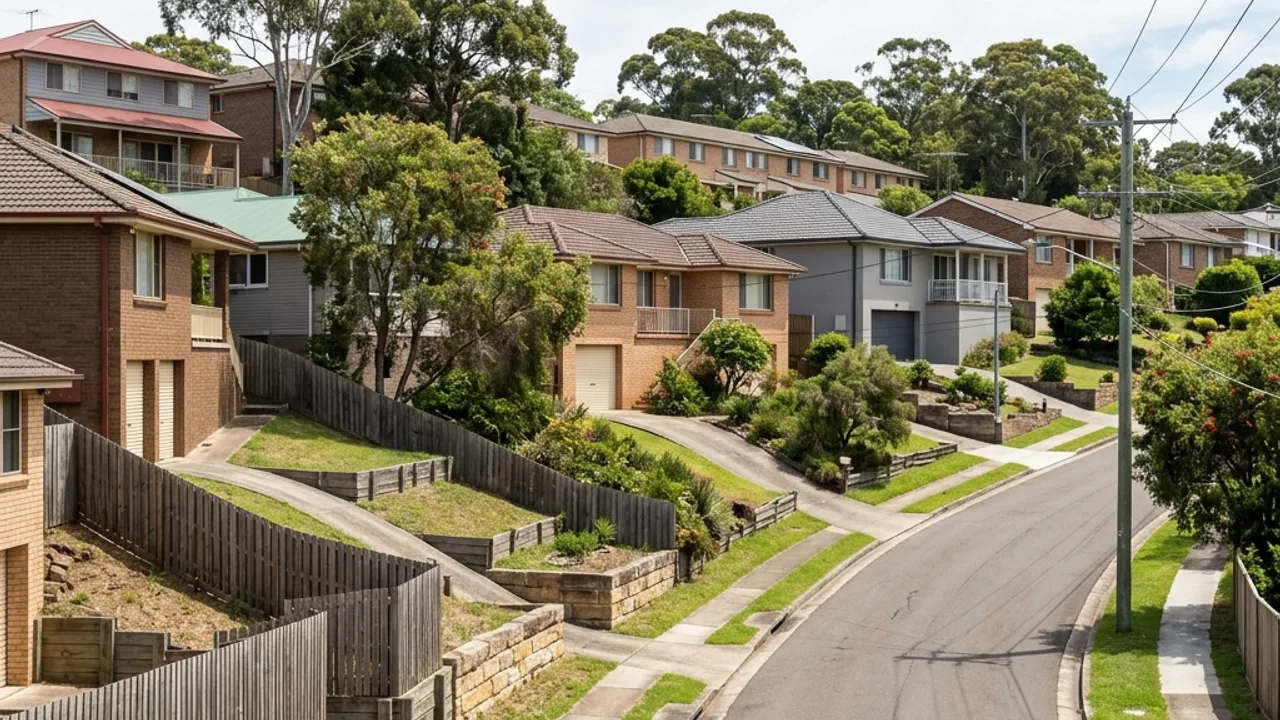
Retaining Walls and Fencing in Ipswich
Heritage-era blocks near the Bremer River sit on reactive clay, so ageing retaining work is a common enquiry here.
Ipswich is older than most of the region it sits in, and the retaining work reflects that. Around the city centre you are typically dealing with structures added to properties built long before modern drainage detailing, on ground that moves with the seasons, which is a different problem from a new estate cut.
Retaining wall installation in Ipswich, west of Brisbane
Reactive clay is the local factor that changes the engineering answer. Clay soils near the Bremer swell when wet and shrink when dry, and that seasonal movement is transmitted into anything founded in them. For a retaining wall it means footings and drainage carry more of the design responsibility than the face material does, and it means an existing wall that has shifted may be responding to ground movement rather than to load alone. Site classification governs how a wall is designed on that ground, and it is established by a soil test rather than assumed from the street. Any quote that specifies a footing without knowing what it is founding into is guessing.
The older housing stock adds a second consideration. Walls on established Ipswich properties are frequently brick or mortared stone rather than sleeper, and they were often built without the subsoil drainage that current rules require behind every retaining wall. Where such a wall is bulging, cracking through the mortar joints or shedding material, reinstating drainage is usually a bigger part of the fix than rebuilding the face. Approval triggers apply here the same way they do elsewhere in Queensland: more than 1.0 metre of retained height, a surcharge at any height, or a wall within 1.5 metres of a building or another wall each bring building approval into play.
Why Ipswich owners use our help
We treat seasonal ground movement as a
We treat seasonal ground movement as a design input on this ground, because a wall that moves with the clay needs different footings from one that does not.
We say plainly when a soil test
We say plainly when a soil test is warranted rather than pricing a footing on assumption, since that assumption is where the expensive mistakes start.
We look at drainage first on older
We look at drainage first on older masonry walls, as reinstating it is usually more of the real fix than rebuilding the visible face.
About Ipswich
Ipswich centres on postcode 4305 around the Ipswich CBD heritage precinct, where the street grid and much of the building stock predate almost everything in greater Brisbane. Queens Park sits immediately south-east of the centre and remains the main open space for the city, while the Bremer River curves around the northern side and sets the low ground. Housing runs from genuine nineteenth-century cottages through interwar and post-war timber homes to later brick-veneer on the fringes. Blocks near the centre are frequently narrow with lanes or shared access behind them. The result is a city where the retaining and fencing questions are as often about maintaining something old as about building something new.
What makes a Ipswich site different
Limestone Street and East Street run through the older grid where properties sit close together and rear access is limited, so material handling on a job near the centre is closer to inner-Brisbane conditions than to the open estates further out. Brisbane Street carries the main commercial traffic through the city. On the low ground toward the river, walls and fence posts sit in ground that holds moisture well after rain and dries hard through winter, and timber that was never treated for in-ground use in that cycle fails at the collar rather than above it. Character-era properties also tend to have had several rounds of work over a century, so it is common to find two or three different wall systems on one block, none of them documented.
Retaining wall and fencing services available in Ipswich
Get help with your Ipswich project
Planning a retaining wall or fence in Ipswich?
Tell us what is happening in Ipswich and we will help you take the next step.
Send us the details
A photo of the boundary or the existing structure speeds things up. Send it with the form below.
Adjacent suburbs we also cover
Ipswich sits alongside North Ipswich, East Ipswich and Woodend, and the same ground and boundary conditions carry straight across those streets.