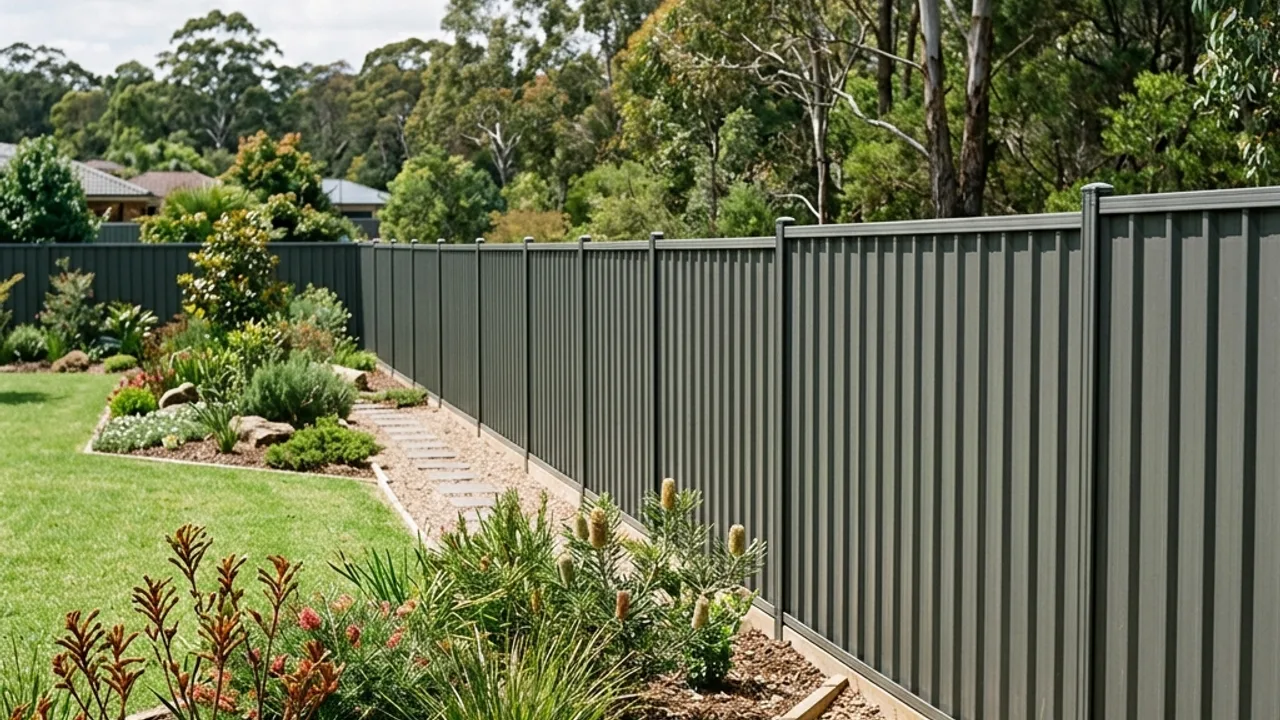
Colorbond Fencing In Brisbane, Ipswich And The Coasts
Steel panel boundary fencing in the standard Australian colours, priced properly. If you are holding two quotes that are thousands apart, this page explains why.
What a Colorbond fencing Brisbane quote actually covers
Colorbond is the pre-painted steel sheet fencing system most Queensland boundaries end up with, and the reason is straightforward. It does not need painting, it does not rot, it holds a straight line across a long run, and in the standard colours like Woodland Grey, Monument and Basalt it disappears into a yard rather than dominating it. On a typical residential boundary it is the lowest-maintenance option available.
What surprises people is the price. Panels are a modest share of an installed fence. The rest is posts, bored footings, concrete, rails, plinths where the ground falls away, cutting and stepping the run to follow the fall, hardware, and the labour to get it plumb and straight. That is why a materials estimate from a supplier's site and a real quote look like different products. They are pricing different things.
What an installed Colorbond fence includes
Bored and concreted post holes
Post spacing and footing depth follow the fence height, the wind exposure and the ground. Solid panels catch wind, and the footing is what resists it.
Posts, rails and infill sheets
The structure behind the face. Rail count and post gauge are specified for the panel height rather than being one standard set across every job.
Stepping or raking to the fall
On sloping ground the run either steps in panel increments or rakes with the slope. Which one suits is decided on site and changes the panel count.
Ground gap treatment
Where the ground falls away under the fence line, a plinth, the board that closes the gap along the ground, keeps pets in and soil out.
Removal of the old fence
Demolition, old post extraction and disposal are real work and real tip fees. When they appear on one quote and not another, that alone can be the difference.
Gates and hardware to match
Pedestrian and double gates in matching colour, with hinges and latches rated for the panel weight rather than the lightest option in the catalogue.
Why two quotes for the same fence come back thousands apart
Homeowners routinely compare quotes for the same boundary that differ by several thousand dollars, and the reason is almost never one contractor being greedy. It is inclusions. One price has the old fence removed and carted away, another leaves it to you. One has bored footings to a depth suited to the ground, another has shallower holes that will do until the first serious storm season. One steps the run properly down a fall, another quotes a flat line that will not survive contact with your block.
Site conditions do the rest. Rock, tree roots, old concrete and buried services all slow the boring. Access decides whether materials come in by ute or by hand. Length works in your favour, since set-up and travel spread across a longer run and the per-metre rate drops. The way to compare fairly is to put the quotes side by side on inclusions first and total second, and to ask for the same scope from each.
Licensing, and where the threshold sits
A fence is a fixed structure, so building one is regulated building work. In Queensland a contractor must hold a QBCC licence to construct a fence on residential land where the value of the work is $3,300 or more including both labour and materials. Most full Colorbond boundary replacements clear that comfortably, so a professional fencer doing your job is expected to be licensed for it.
There are real exemptions and it is worth knowing them rather than assuming the rule is universal. A wire fence with no concrete footing, made of posts, pickets or stakes joined by strands of wire, is exempt regardless of value, and fencing on agricultural or pastoral land carries its own exemption too, worth confirming with QBCC since the value detail has been subject to change. Certain owner-built work is also outside the licensing requirement. What none of those exemptions do is cover a paid contractor installing a steel panel fence on a suburban block, which is the job this page is about.
Coastal exposure and hardware choice
Salt air is the one condition that changes the specification rather than just the price. On blocks near the Broadwater, around Burleigh, along the Mooloolaba and Caloundra foreshores or anywhere taking regular onshore wind, corrosion works on the fixings and fittings long before it troubles the panels. Fasteners, hinges, latches and post caps are where a coastal fence shows its age first.
The practical answer is to specify hardware for the exposure rather than accepting the standard kit and hoping. That is a conversation worth having at quoting stage, because retrofitting better fittings to an installed fence is fiddly and rarely done. Inland, across most of Brisbane and the Ipswich corridor, the standard specification is appropriate and the money is better spent on footing depth than on corrosion resistance.
Getting a Colorbond boundary quoted
- 1
Measure the run
Rough length in metres, the height you want, and whether the ground falls along the line. A photo of the boundary tells the specialist most of what they need to know.
- 2
Site look
Ground conditions, access, services, the existing fence, and whether the neighbour side is part of the conversation.
- 3
Itemised written quote
Removal, footings, panels, stepping, plinths and gates listed separately so you can compare it against anything else you hold.
- 4
Install
The old fence comes out, posts are bored and set, then panels and rails go in once the concrete has taken. Gates are hung and adjusted last.
What we make sure your quote answers
Inclusions written down, not implied
Removal, disposal, footing depth and stepping are the four items that quietly separate two prices. We push for them to be visible so you are comparing the same fence.
Footings sized for wind, not habit
A solid panel fence carries the whole wind load on its footings. Exposed ridge and coastal blocks need more than the standard hole, and that is a specification question rather than an upsell.
Colour and height settled early
Standard colours and common heights are stocked, unusual combinations are not. Getting that fixed at quoting stage is what keeps the install date honest.
Still weighing the options? The timber fencing and retaining wall repairs & replacement pages cover the nearest alternatives, the cost calculator puts an indicative band against each, and the full service list shows where this one sits.
Colorbond across the four regions
The job varies more than the product does. On established Brisbane streets a Colorbond run is usually replacing a tired paling fence, which means demolition, old post extraction and a boundary line that has probably shifted a little since it was first set. In the newer Ipswich corridor estates around Springfield Lakes, Ripley and Redbank Plains, it is more often a first fence on a graded block, going in around the same time as the retaining, with both trades working to the same finished levels.
On the coast, exposure drives the detail. Southport, Burleigh Heads, Mooloolaba and Caloundra blocks all sit in salt-laden air, and hardware specification matters there in a way it does not in Ipswich. In the hinterland around Mudgeeraba and Nambour, the fall across a block is the constraint instead, and how the run steps down that fall decides both the panel count and how the finished fence looks from the house.
Colorbond Fencing across Brisbane
Ground, exposure and what is already on the boundary change the job suburb by suburb. Pick yours for the local notes.
Colorbond fencing questions
How much does a Colorbond fence cost in Queensland?
What is the difference between Colorbond and timber boundary fencing?
Do I need a licence to build a fence in Queensland?
How long does a full boundary fence replacement take?
How tall can my fence be without council approval in Queensland?
Get an itemised Colorbond fencing quote
Send the length, the height and a photo of the boundary. You will get a written response with the inclusions spelled out rather than bundled into one figure.
Talk to a specialist
Ready to start your Brisbane retaining walls and fencing?
Share the details and we will help you take the next step with confidence.