
Retaining Wall Repairs And Replacement Across South East Queensland
Leaning, bulging, rotted or holding water. Get the wall looked at properly before deciding between a repair and a rebuild, because the two are very different numbers.
What retaining wall installation Brisbane assessments look for on an ageing wall
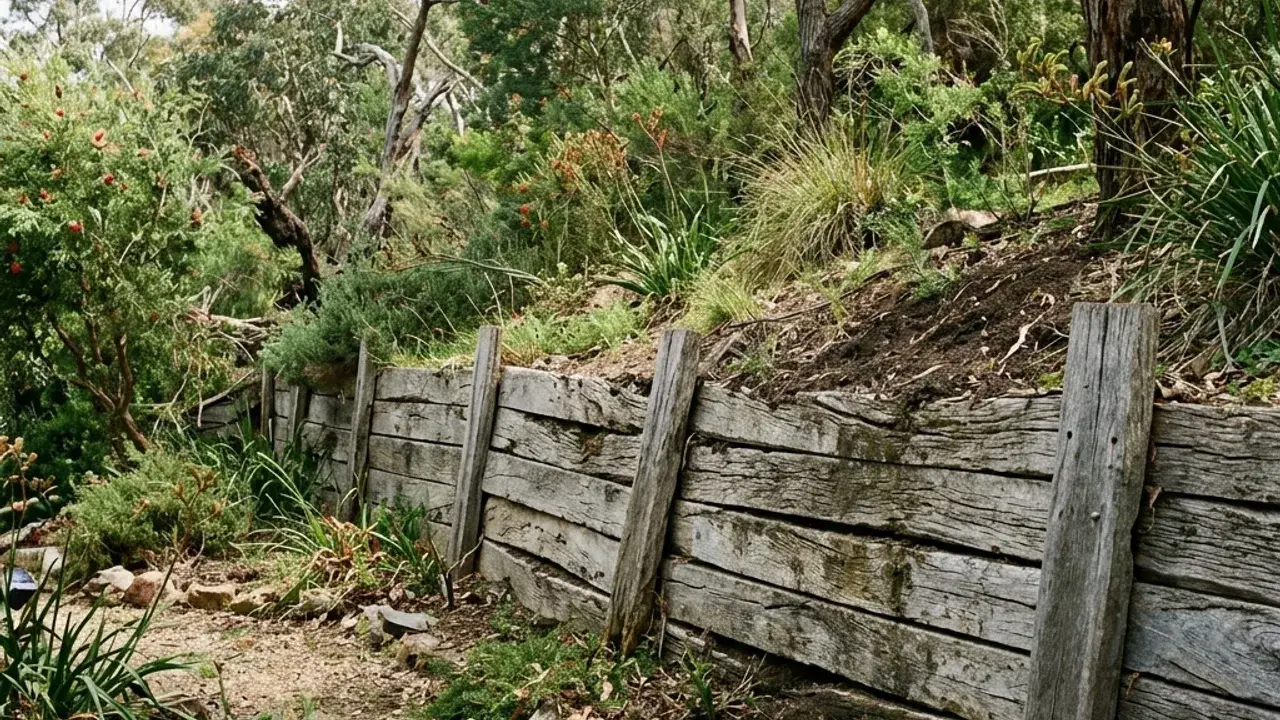
If your wall is leaning outward at the top, bulging in the middle of a run, showing bowed or softened sleepers, or holding water at the base after rain, it is telling you something specific. Those symptoms are not general wear. They are what happens when water pressure builds behind a wall faster than it can escape, or when the material holding the cut has lost the section it needs to keep holding it. Reading which of those is happening is the whole assessment.
This is the only page on this site about a structure that already exists, and it is the enquiry we get most. The useful outcome is not a quote for a rebuild. It is knowing whether you are looking at reinstating drainage behind a sound wall, replacing a section, or accepting that a wall built decades ago has reached the end of what it was built for. Those three answers are separated by a lot of money, and guessing between them is how people spend twice.
What an assessment covers
Movement and lean measurement
How far out of plumb the wall has gone, whether the movement is uniform or concentrated, and whether it is still moving or settled years ago.
Drainage investigation
Whether an agi pipe was ever installed behind the wall, whether it is silted or crushed, and where the water currently ends up after a storm.
Material condition check
Rot and insect damage in timber, corrosion at post bases, cracking in masonry, and whether the failure is the face, the posts or the footing.
Load and surcharge review
What has been added above the wall since it was built. Decks, carports, driveways and raised houses all change what the original wall was asked to hold.
Access assessment
Whether machinery can reach the wall, or whether removal and rebuild has to happen by hand through a side gate. This is usually the biggest cost variable.
Repair, section or full rebuild
A recommendation with the reasoning behind it, including what a repair would and would not fix, so the choice is yours to make on real information.
Drainage is almost always the root cause behind a failing sleeper retaining wall
Queensland building rules require subsoil drainage behind retaining walls, and inadequate drainage is the leading cause of wall failure. That is not a marketing line, it is the single most consistent finding on ageing walls across the region. Soil that cannot drain holds water, water behind a wall exerts pressure the wall was never designed to resist, and that pressure is what produces the lean and the bulge people ring about.
This matters for the repair decision because straightening a face without fixing the water does not fix anything. It resets the clock on a problem that will run again. A genuine repair reinstates free-draining gravel, a functioning agi pipe, geofabric keeping soil out of the drainage layer, and a discharge point that stays inside your property rather than pushing stormwater onto a neighbour. Where the wall itself is still sound, that work alone can be the whole job.
Repair, replace a section, or rebuild a core-filled block wall
The practical test is whether the structure has lost capacity or just lost its drainage. A masonry or concrete wall that has moved because water built up behind it is often worth saving. A timber wall with soft sleepers and post bases that crumble when probed has lost the material doing the work, and patching a course of that is money spent on a wall that will fail somewhere else next season.
Partial replacement sits between the two and is genuinely common. Walls fail in the section where water concentrates, which is often one end of a run or the low point of a fall, while the rest of the wall is still doing its job. Where the sound and failed sections can be separated cleanly, replacing the failed portion and reinstating drainage across the whole length is usually the sensible answer. Where the wall was built as one continuous element, it generally has to be handled as one.
Why access changes the price so much
Cost on this work is driven less by the wall than by what it takes to get to it. A wall on an open frontage where a machine can dig, load and remove spoil directly is a straightforward job. The same wall in a back corner, behind a pool, down a set of stairs or between two houses becomes a hand-demolition job with barrows, and the old material still has to be carried out and disposed of. That difference is real work, not padding.
Replacement also brings the current rules with it, which the original wall may predate. A rebuilt wall is assessed on what it does today, so if the height, a new surcharge above it, or its distance from a building trips the approval test, approval and engineering apply to the replacement even though the original never had them. On the Sunshine Coast the council goes further, expecting a building permit before construction, modification or repair of most retaining walls.
How we get you to a decision
- 1
Send photos and symptoms
A photo along the wall face, one straight on, and a line about when the movement started and what the ground does after rain.
- 2
On-site assessment
Movement measured, drainage investigated, material condition checked, and the load above the wall reviewed against what it was built for.
- 3
A recommendation with reasoning
Repair, part replacement or rebuild, with what each option does and does not solve, so the trade-off is visible.
- 4
Written quote for the chosen path
Fixed price, with removal, disposal, drainage and any approval requirement itemised rather than bundled.
How we approach an existing wall
No pressure toward the bigger job
If reinstating drainage behind a sound wall will fix the problem, that is what you will be told. A rebuild recommended on a wall that did not need one is the fastest way to lose a homeowner's trust.
The cause gets diagnosed, not just the symptom
Straightening a face without dealing with the water behind it buys a couple of seasons. We would rather find out where the water is going and price the fix that actually holds.
Access priced honestly upfront
Hand demolition and barrow access cost more, and pretending otherwise just produces a variation later. You will see it in the quote before you commit, not after.
Still weighing the options? The colorbond fencing and besser block (core-filled) retaining walls pages cover the nearest alternatives, the cost calculator puts an indicative band against each, and the full service list shows where this one sits.
Why so many walls in this region are due
There is a clear pattern behind the volume of repair enquiries across Brisbane. A great deal of the city's post-war and interwar housing was set on hand-cut benches held by timber sleeper walls, and those walls are now decades into a service life nobody designed to be indefinite. Suburbs on the rises and gullies of the inner west and the south-east, where cross-fall is normal, carry a lot of them. When a wall of that vintage starts moving, it is usually not a surprise, it is timing.
Two local factors accelerate it. Creek catchments running through the suburbs concentrate stormwater, and a wall sitting in that path handles more water than its original drainage was sized for. And the Brisbane habit of raising a house and building underneath adds a surcharge close to the original cut, loading a wall that was built to hold soil alone. In the Ipswich area, heritage blocks near the Bremer sit on reactive clay that moves with moisture, which produces the same lean by a different route.
Retaining Wall Repairs & Replacement across Brisbane
The age and style of the walls we look at changes a lot from one suburb to the next. Pick yours for the local detail.
Repair and replacement questions
How do I know if my retaining wall needs repair or full replacement?
Why does my retaining wall keep leaning?
Why is drainage so important behind a retaining wall?
Do older Brisbane Queenslander blocks commonly need retaining wall work?
Does the Sunshine Coast have different retaining wall rules to Brisbane?
Get your wall assessed before it moves further
Send a couple of photos and a note on when the movement started. You will get a written response on whether this reads as a repair or a rebuild.
Talk to a specialist
Ready to start your Brisbane retaining walls and fencing?
Share the details and we will help you take the next step with confidence.