
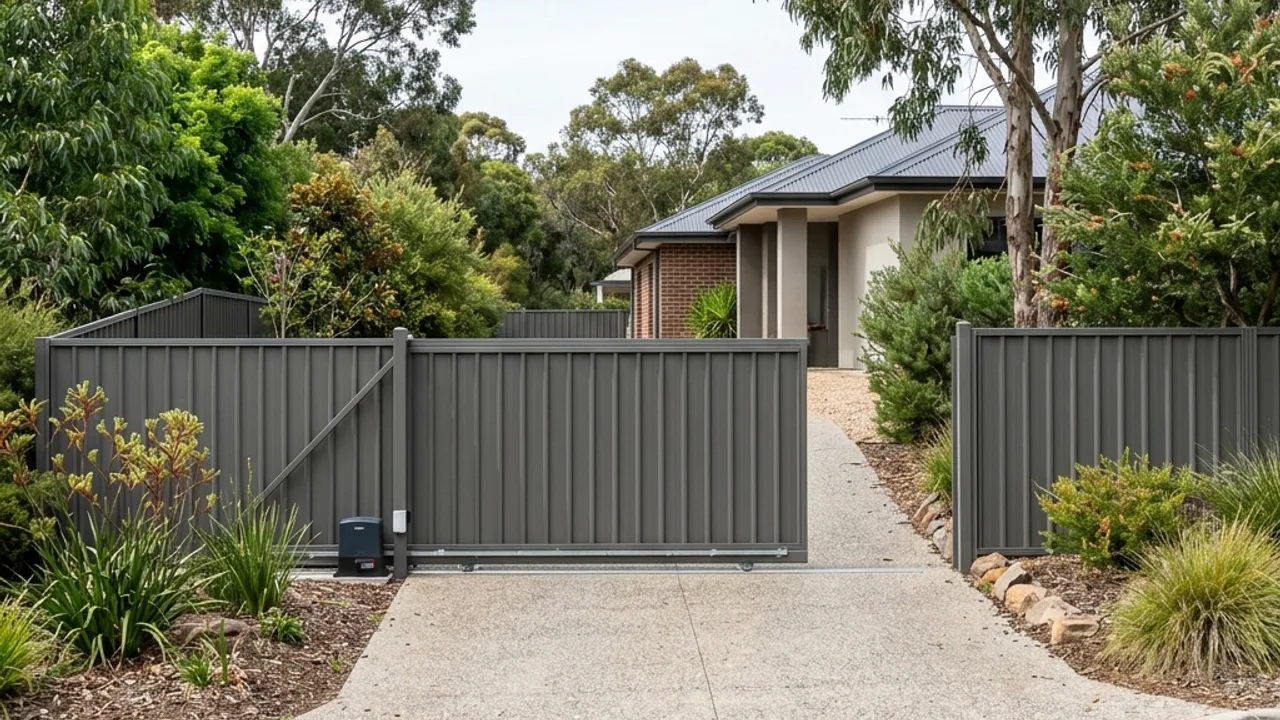
Driveway Gates And Gate Automation Across South East Queensland
Sliding, swing and solar-automated gates matched to the fence line they sit in. The driveway usually decides which type suits, well before the look does.
Matching a driveway gate to the fencing Brisbane blocks already have
A driveway gate is the one part of a boundary that has to work mechanically every day, which makes it a different problem to the fence it sits in. Get the type wrong for the driveway and you get a gate that scrapes on the fall, needs a run-back area you do not have, or asks an opener to do something it was never sized for. Get it right and it is the least noticed thing on the property.
Most people arrive here at one of two moments. Either a new fence has just gone in and the driveway is the last gap in the line, or an existing manual gate has become tiresome enough that automating it is worth the spend. The questions are the same either way. How wide is the opening, how does the ground fall across it, how much room is there beside the driveway, and is there power nearby.
What a gate job covers
Opening measure and gate type
Width, grade across the opening and the space available beside the driveway. Those three decide sliding or swing before any preference does.
Gate frame and infill
A structural frame with infill chosen to match the adjoining fence, whether that is steel sheet, aluminium slats, timber palings or a mixed panel.
Posts, footings and track
Gate posts carry far more than line posts do and are footed accordingly. A sliding gate also needs a level track or cantilever rail set true.
Automation and power
An opener sized to the gate weight and duty, run from mains where it is available or from a solar and battery setup where trenching is impractical.
Access controls
Remotes, keypads, intercom integration and safety devices, specified to how the entry is actually used rather than to the largest available kit.
Finish matched to the fence line
Colour and profile matched to the run either side so the gate reads as part of the boundary rather than as a separate object bolted into it.
Sliding, swing, or neither
Sliding gates run sideways along the boundary, so they need clear run-back space beside the driveway but almost no room in front or behind. That makes them the answer on narrow blocks, on driveways that rise away from the street, and anywhere a swinging leaf would foul on a slope or open into the road. The trade is that the run-back area has to stay clear permanently, which rules them out where the fence line runs straight into a garden bed or a wall.
Swing gates suit wide, reasonably flat entries with room for the leaf to travel. They tend to look more at home on a rural-style or character frontage, and a double swing halves the space each leaf needs. Where the driveway rises, a swing gate has to be hung to clear the grade, which is a design consideration rather than a problem. Where neither works cleanly, a bi-fold or a cantilever arrangement usually does, and that is a conversation for the site visit.
Automation, power and what solar really does
The opener has to be matched to the gate, not the other way around. Weight, width, duty cycle and how the gate is used all feed into which unit suits. A heavy steel sheet gate on a busy driveway asks far more of an opener than a light aluminium slat gate opened twice a day, and undersizing there is the most common cause of a gate that becomes unreliable within a couple of years.
Solar automation is a genuine option rather than a compromise, and it matters most where the gate sits a long way from the house or where trenching a power run would mean cutting a finished driveway. A panel and battery sized to the number of daily cycles will run a residential gate without mains power. What it will not do is rescue an undersized opener on an oversized gate, and it needs the panel to sit somewhere with real sun. If mains power is already at the gate, use it.
Heights, sight lines and where the gate sits
Fences up to 2 metres above natural ground are generally accepted development in Queensland when they meet the siting rules, and anything over 2 metres needs approval from a building certifier. Where a fence or gate sits on top of a retaining wall, the two are assessed on their combined height, and approval or siting discretion is generally triggered once that combined height passes 2.0 metres above natural ground level. On a benched driveway with a wall along it, that combination is easier to reach than people expect.
Corner blocks have their own constraint. The siting rules require sight lines at intersections, so fencing within the truncated corner is kept low enough that drivers can see across it. If your driveway comes off a corner, that shapes both where the gate can sit and how high the fence beside it can be. Worth checking before the gate is fabricated rather than after.
From opening measurement to working gate
- 1
Send the opening
Width across the driveway, how the ground falls, what sits either side, and whether there is power near the gate line.
- 2
Site look
Run-back space, grade, the existing fence profile, and where an opener and its controls can realistically live.
- 3
Written quote
Gate, posts and footings, track or hinges, opener, power arrangement and controls priced as separate lines.
- 4
Install and commission
Posts set, gate hung or tracked, opener fitted and travel limits set, then remotes and safety devices tested through a full cycle.
What we check before quoting a gate
The driveway picks the gate type
Grade, width and run-back space come before appearance. A gate chosen on looks alone and fitted to the wrong entry is the most expensive way to learn this.
Openers sized for real use
Duty cycle and gate weight decide the unit. An opener working at the edge of its rating on a busy entry is where reliability complaints start, and it is avoidable at quoting stage.
Finish matched to the boundary
Colour, profile and height matched to the fence either side. A gate that reads as part of the run is worth more than one that stands out for the wrong reason.
Still weighing the options? The concrete sleeper retaining walls and pool fencing pages cover the nearest alternatives, the cost calculator puts an indicative band against each, and the full service list shows where this one sits.
Gates on South East Queensland driveways
Grade is the constant across this region. Driveways off the ridges and gullies in Brisbane's inner west rise or fall sharply from the street, which is why sliding gates and cantilever arrangements are so common there, and why a swing leaf that looks fine on a plan fouls on the actual slope. On the acreage-edge blocks out around Chapel Hill and Kenmore, the entry is often set well back down a long drive, which is exactly where a solar setup earns its place over trenching a power run.
Elsewhere the drivers change. In the Ipswich growth corridor, new-estate blocks around Springfield Lakes and Ripley are graded flat at the frontage, so the choice opens up and matching the gate to a brand new fence line becomes the main consideration. On the coast at Southport, Mooloolaba and Caloundra, salt air is again the deciding factor on hardware, since hinges, rollers and latches take the exposure long before the gate frame shows anything.
Gates & Gate Automation across Brisbane
Driveway grade, frontage and exposure all change the gate job. Pick your suburb for the local notes.
Gate and automation questions
How much does a Colorbond fence cost in Queensland?
How long does a full boundary fence replacement take?
Do I need to be home during a fence or retaining wall installation?
Can a damaged fence panel be repaired instead of replacing the whole fence?
Who pays for a dividing fence between neighbouring properties?
Get a driveway gate quoted for your entry
Send the opening width, the fall across it and a photo from the street. You will get a written response covering the gate type, the opener and the power options.
Talk to a specialist
Ready to start your Brisbane retaining walls and fencing?
Share the details and we will help you take the next step with confidence.