Pool Fencing And Compliant Pool Barriers In South East Queensland
Glass and aluminium barriers built to the Queensland pool safety standard, whether you are fencing a new pool or getting a property ready to sell or lease.
What pool fencing Brisbane and coastal owners have to meet
Pool barriers in Queensland are governed by the pool safety standard, Queensland Development Code Mandatory Part 3.4, which applies AS 1926.1 under the Building Act 1975. In practical terms that means a barrier at least 1200mm high measured from finished ground, a gate latch release at least 1500mm above ground, a 900mm non-climbable zone, which is the arc around the barrier that has to stay clear of anything a child could use as a foothold, and gaps between vertical members of no more than 100mm. Gates must be self-closing and self-latching from any position and swing outward from the pool.
This is the one page on this site where the requirement is not a matter of preference. Compliance is confirmed by a licensed pool safety inspector, not by a builder's opinion and not by working through a checklist yourself. If you are selling or leasing, a pool safety certificate is part of the transaction, and a barrier that does not meet the standard becomes a settlement problem rather than a maintenance one.
What a compliant barrier install involves
Barrier height and ground levels
The 1200mm minimum is measured from finished ground on the outside. Changing the levels around a pool later can put a compliant barrier out of compliance.
Non-climbable zone planning
The 900mm zone has to stay clear of footholds, which affects where planters, retaining walls, pumps, furniture and horizontal rails can sit.
Gate, hinges and latching
Self-closing and self-latching hardware with the release at least 1500mm above ground, hung to swing away from the pool and adjusted to close from any position.
Panel gaps and ground clearance
No more than 100mm between vertical members and no more than 100mm under the barrier, which matters most where the ground falls away along a run.
Glass or aluminium selection
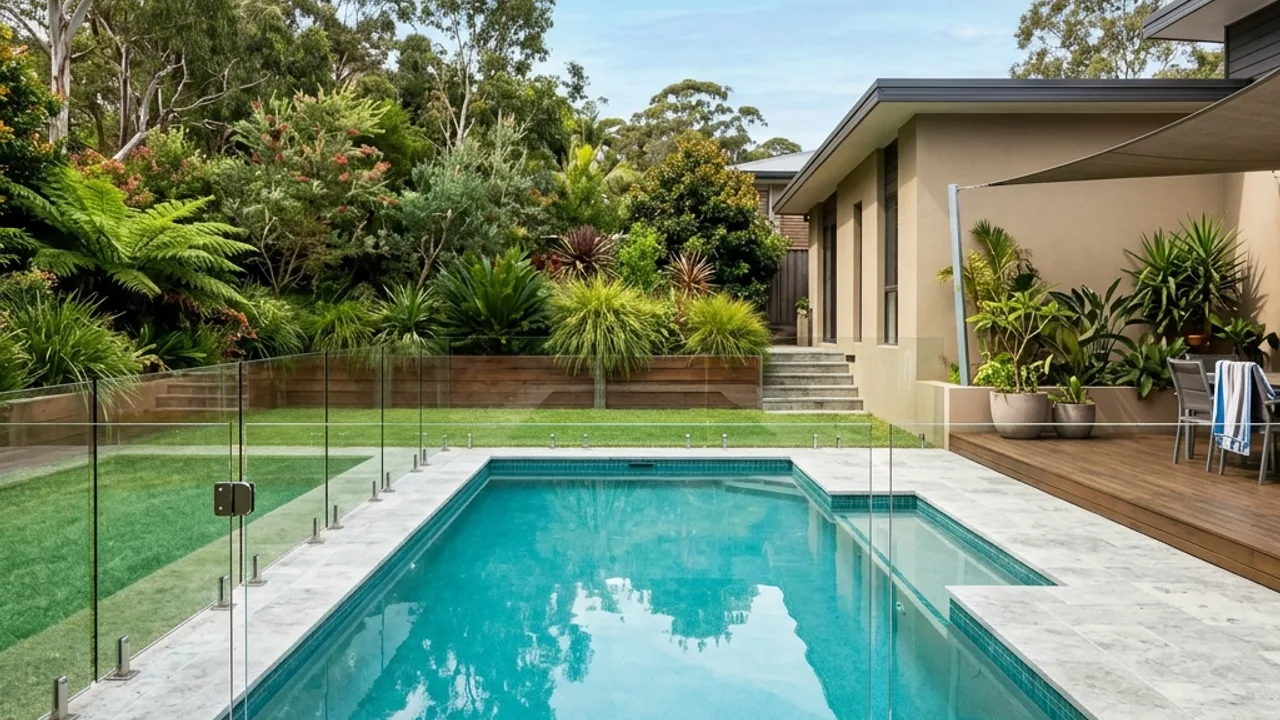
Frameless and semi-frameless glass for an open outlook, powder-coated aluminium for cost and coastal durability. Both can be built compliant.
Inspection-ready handover
The barrier built so a licensed pool safety inspector can assess it, with the surrounds and levels set as they will actually be left.
Glass or aluminium
Glass is chosen for the view. Frameless and semi-frameless panels keep the pool visually connected to the yard and the house, which is the whole point on a small block where a solid barrier would make the space feel closed in. It costs more, it shows water spots and it needs cleaning, and on a windy site it catches more than an open picket barrier does. None of that stops it being the right choice where the outlook matters.
Aluminium is the practical answer. Powder-coated vertical picket panels cost less, tolerate coastal air well when the coating and fixings are specified for it, and are simpler to work around awkward levels and returns. Plenty of pools end up with both, glass across the frontage that is seen from the living areas and aluminium down the sides where nobody looks. The compliance requirements are identical either way.
Certificates, and when you need one
A pool safety certificate is issued by a licensed pool safety inspector and is valid for two years for a non-shared pool and one year for a shared pool. You need a current certificate when you sell or lease a property with a pool, which is why the barrier question tends to surface under time pressure, in the middle of a sale campaign rather than at leisure.
The useful move is to get it looked at before you list rather than after a buyer's building and pest report raises it. Common findings are not exotic. A gate that no longer self-latches from every position, a climbable object that has crept into the non-climbable zone, ground levels changed by new paving or turf, and a gap that has opened where a fence line has moved. Most are fixable. All of them are cheaper to fix on your own timeline.
Who can sign it off, and who cannot
Compliance is assessed by a licensed pool safety inspector working under the Building Act 1975, and that licence is separate from a trade licence. An inspector cannot personally carry out repair work on a pool barrier valued over the QBCC threshold unless they also hold the relevant QBCC licence, which is why inspection and rectification are often two different people. That is normal rather than a red flag.
On the installation side, licence class depends on the material. Glass and aluminium barrier work sits with glass, glazing and aluminium classes, along with builder and pool construction classes. Our network of QBCC-licensed contractors is matched to the class the work falls under. What we will not do is tell you a barrier is compliant, because that is the inspector's call and nobody else's, and treating it as anything less than that is how non-compliant barriers get built with the best intentions.
Getting a pool barrier sorted
- 1
Tell us the situation
New pool, an existing barrier that needs work, or a certificate needed for a sale or lease. The three run differently.
- 2
Site measure
Levels, the barrier line, the non-climbable zone, and everything standing within it. Retaining walls and planters get looked at closely here.
- 3
Written quote
Panels, posts, gates and hardware itemised, with any level or landscaping changes the barrier line depends on called out.
- 4
Install, then inspection
Barrier built and gates adjusted, then a licensed pool safety inspector assesses it and issues the certificate.
How we treat pool barrier work
The inspector decides, and we say so
You will not get a compliance guarantee from this site, because that is not ours to give. What you get is a barrier built to the standard the inspector assesses against, by someone who works to it daily.
The non-climbable zone gets planned early
Most failed inspections come down to something in the 900mm zone rather than the barrier itself. Planters, pumps, walls and furniture get considered at quoting stage, not after.
Timed around your settlement
When the certificate is tied to a sale or a lease, sequencing matters more than anything. We will be straight with you about what fits the timeline and what does not.
Still weighing the options? The gates & gate automation and timber fencing pages cover the nearest alternatives, the cost calculator puts an indicative band against each, and the full service list shows where this one sits.
Pool barriers across a region full of pools
Pool density on the Gold Coast and Sunshine Coast is high, and the barrier work there carries conditions inland jobs do not. Salt air off the Broadwater at Southport, around Burleigh Heads and along the Mooloolaba and Caloundra foreshores works on hinges, latches and fixings, and a self-latching gate that has corroded is both a maintenance problem and a compliance one. Coastal barrier specification is genuinely different, and it is worth raising when the quote is written rather than when the certificate is due.
In Brisbane and the Ipswich corridor the recurring complication is levels. Pools on sloping blocks are usually built off a benched platform with retaining around them, and where a retaining wall forms part of the pool barrier it brings the wall itself into the approval net at any height. New estates around Springfield Lakes and Ripley put pools into yards where the ground is still being landscaped, and paving or turf added after the barrier went in can change the measured height under it.
Pool Fencing across Brisbane
Exposure, levels and how the pool sits in the yard change the barrier job. Pick your suburb for the local notes.
Pool fencing and compliance questions
What are the pool fencing requirements in Queensland?
How often do I need a pool safety certificate?
Do I need a licence to build a fence in Queensland?
Do I need to be home during a fence or retaining wall installation?
Can I get a quote before deciding on materials?
Get your pool barrier looked at properly
Tell us whether this is a new pool, an existing barrier or a certificate for a sale. You will get a written response covering what the work involves.
Talk to a specialist
Ready to start your Brisbane retaining walls and fencing?
Share the details and we will help you take the next step with confidence.